

2026.10.24
amux: A Self-Hosted Control Plane for Multiple AI Coding Agents
amux coordinates AI coding agents through a shared board, messaging, schedules, and recovery features. Before adoption, verify its license, CLI requirements, tmux dependency, and deployment permissions.
What it is for
amux is a control plane for AI coding agents. It places agents such as Claude Code, Codex, and Gemini CLI behind one dashboard, making it suitable for developers who want to advance several coding tasks in parallel while retaining a central view and a way to intervene. The README also describes access from a phone, tablet, Mac, or browser.
It is primarily an orchestration and collaboration layer, not an independent code-generation model. The connected agent CLIs and their accounts or API credentials still perform the work. Adopters should therefore assess model-service access, repository permissions, and usage costs separately.
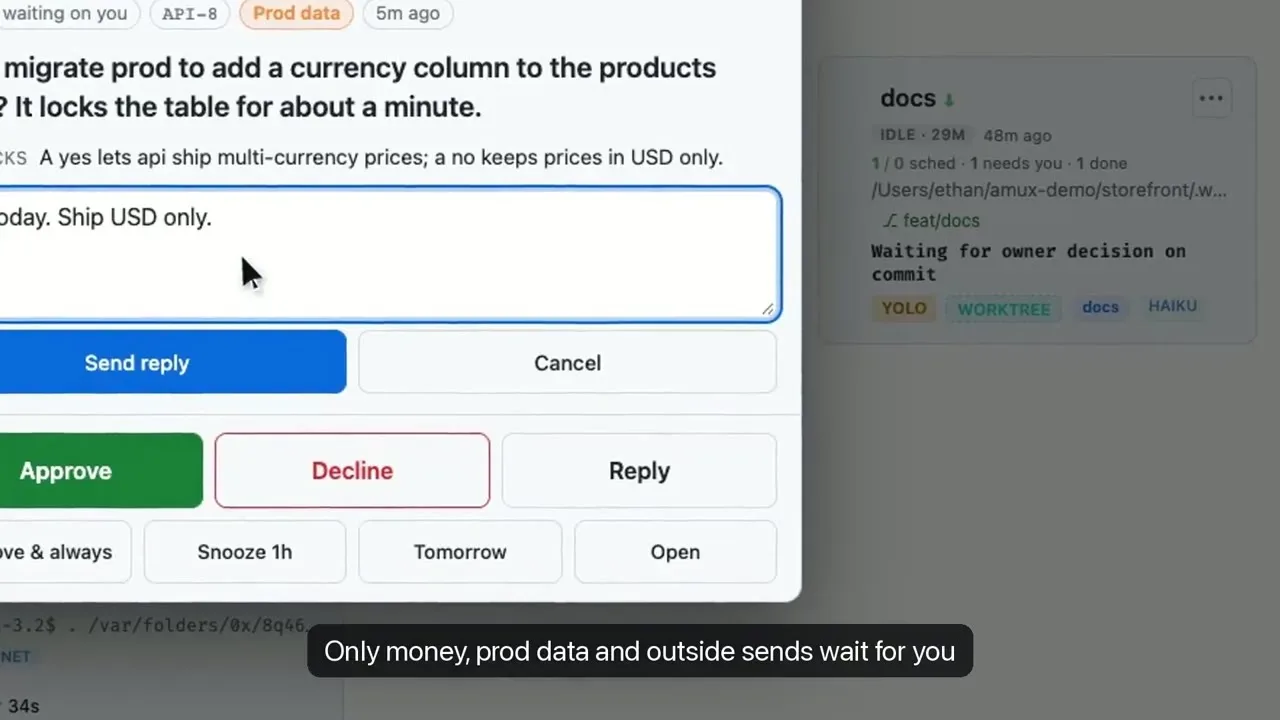
Image source: amux. Published by the project; the interface may vary by version.
Known features
The documented features include a shared task board, atomic task claiming, direct agent-to-agent messages, and scheduled or repeating jobs. Atomic claiming is intended to prevent two agents from taking the same card. The project also says that crashed or stuck sessions can be restarted and resumed. However, the supplied sources contain no independent test results, so this should not be read as a guarantee that every failure will recover automatically.
Local operation is based on a Rust binary and SQLite, with data kept by default under the user’s .amux directory. The README requires tmux 3.2 or newer and at least one of Claude Code, Codex, or Gemini CLI, and states that macOS and Linux are supported. The project page also lists OpenCode and Ollama among switchable model or agent options; the exact compatibility scope should be checked against current documentation.
Who may benefit
amux is aimed at developers comfortable with the command line, tmux, and AI coding agents; small engineering teams; and users who want to split repeatable development work into parallel tasks. The shared board and messaging model can be useful when people need to assign work, approve actions, or monitor long-running sessions.
For occasional questions to a single coding assistant, amux’s multi-agent layer may add unnecessary operational overhead. It should not be assumed to replace a complete CI/CD, code-review, or organizational permission system: the supplied sources do not establish those capabilities.
Limitations and deployment considerations
Start by resolving the license question. Repository metadata reports “Other” with SPDX NOASSERTION, while the project description says MIT. Because these records conflict, a legal review should inspect the repository’s license file rather than relying on the summary.
Agents may access source code, terminals, and credentials. Before deployment, define each agent’s permission boundaries, storage location, network access, and log-handling rules. The available sources are insufficient to make a security claim.
A local installation requires tmux, at least one agent CLI, and a macOS or Linux environment. The Mac app page says it is not yet notarized, so the first launch may require manual approval in system settings. The official v0.9.108 release also records Homebrew and PyPI channels, but its release summary does not provide a complete compatibility matrix. The README lists prices and server specifications for amux Cloud; those are vendor-provided service details and should be verified against the current service pages and data terms before adoption.
Sources
Sources checked: 2026-10-24