

2026.09.25
BTCPay Server: A Self-Hosted Processor for Bitcoin Payments
BTCPay Server suits merchants, creators, and developers who want direct Bitcoin payments and control over their infrastructure. Its broad feature set also brings node, wallet, deployment, and upgrade responsibilities.
What it is for
BTCPay Server is a free, open-source, self-hosted Bitcoin payment processor. It is aimed at merchants, organizations, creators, and developers who want to accept Bitcoin directly rather than depend on a payment intermediary. The README presents it as a peer-to-peer payment tool with invoice management, payment requests, and multi-tenant support.
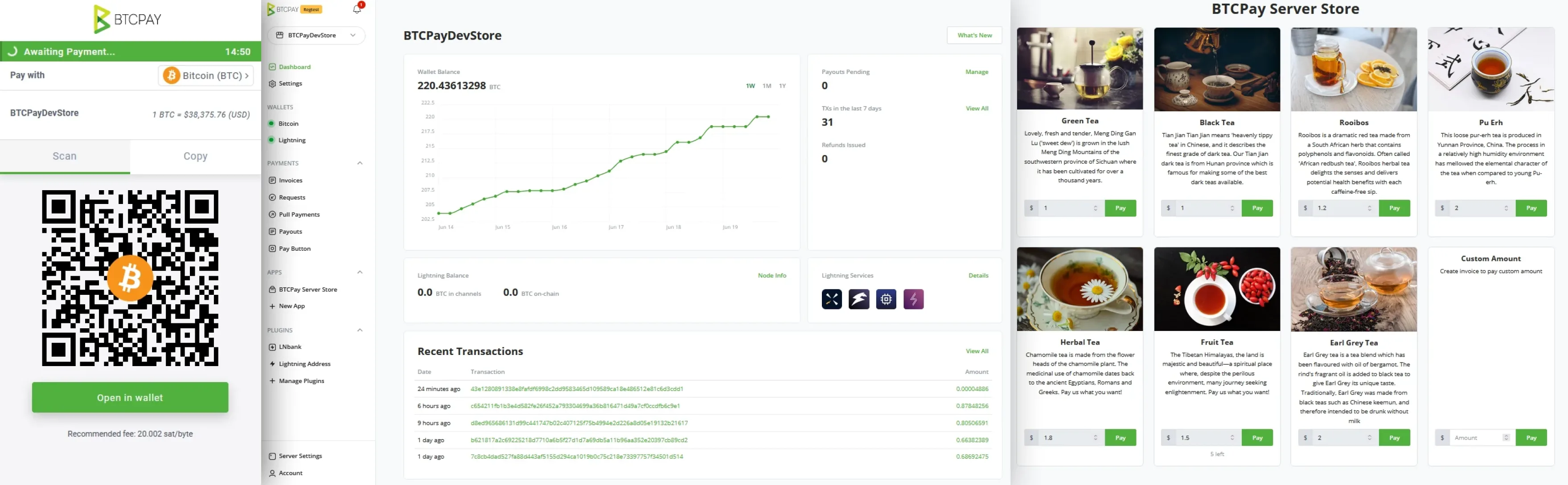
Image source: btcpayserver. Published by the project; the interface may vary by version.
Known features
The project includes apps for point of sale, crowdfunding, and donation buttons. It supports SegWit and the Lightning Network, with LND, Core Lightning (CLN), and Eclair listed in the README. Tor support, hardware-wallet integration, and a full-node-reliant wallet model make it relevant to users who want to manage more of their payment infrastructure themselves.
The project uses the MIT License. The README also distinguishes the Bitcoin-only build from a community-maintained altcoin build. Teams considering other assets should therefore verify the relevant maintenance status and documentation separately rather than assuming identical official support.

Image source: btcpayserver. Published by the project; the interface may vary by version.
Who may benefit
BTCPay Server is a reasonable candidate for teams familiar with Bitcoin wallets, nodes, private-key custody, and payment confirmation. It can also suit developers who want to place checkout, store, or donation flows in infrastructure they control. Operators serving multiple stores or users may find the multi-tenant, store-user, and invoice-management features relevant.
For teams that want to start accepting payments without maintaining servers and nodes, the README also describes a third-party-hosting path. Before choosing it, verify the division of responsibility, pricing, available features, and trust model for the selected host; the supplied sources do not establish a universal price or service level.
Limitations and deployment considerations
Self-hosting does not remove operational work. Operators need plans for node and wallet operation, private-key backups, access control, domains and network exposure, upgrades, and recovery. The supplied sources do not confirm minimum hardware requirements, a complete compatibility matrix, or performance figures, so production sizing should not be inferred from the project page alone.
Lightning also requires more than enabling a setting. The README lists supported implementations and points users to a dedicated guide, but adoption should include checks for liquidity, channel management, settlement, and recovery procedures.
Upgrades require review as well. The official v2.4.4 release notes describe breaking changes including NFC payments being disabled by default, zero-amount invoices being blocked by default, and changes to API-key and BitPay API behavior. Read the release notes for the target version and validate checkout, notifications, permissions, and API integrations in a backup and test environment before production rollout.
Sources
Sources checked: 2026-09-25