

2026.10.03
ClawMetry: A Local Dashboard for AI Agent Sessions and Tool Calls
ClawMetry reads existing agent session files and logs, then presents timelines, tool calls, tokens, and cost data in one dashboard. Before adoption, check runtime coverage, the closed-source companion, default network requests, and uneven observability.
What it is for
ClawMetry is an observability tool for AI agent runs. According to the project README, it reads the session files and logs that coding agents already create, then brings session timelines, tool-by-tool replay, and whatever token and cost data a runtime exposes into one dashboard. The intended use is to distinguish a long run that is making progress from one caught in loops or repeated failures.
The README says the project works with 32 AI agent runtimes and can detect runtimes already present on a machine while reading their data read-only. That makes it relevant to developers, small teams, and maintainers who run several agent tools and want one local view instead of inspecting separate logs. The repository metadata identifies the project as MIT licensed, which may suit users who want to inspect or adapt its open-source portion.
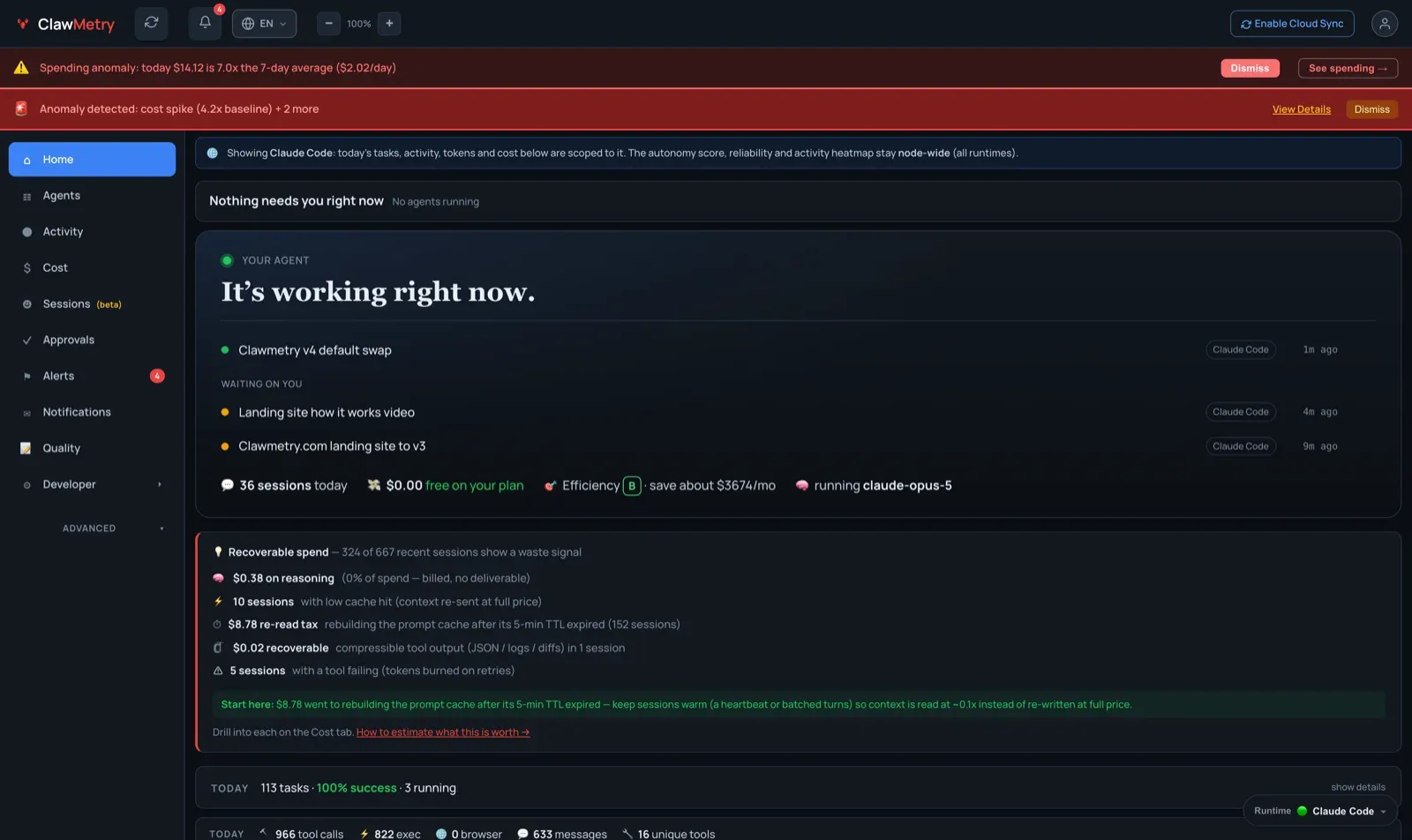
Image source: clawmetry. Published by the project; the interface may vary by version.
Features and free coverage
Listed capabilities include session and transcript views, tool-call replay, token and cost breakdowns, trajectory signals such as looping and repeated failures, and health and log information. The README also mentions flow diagrams, context-window usage, loaded memory and skills, alerts, and approvals. These entries should not be interpreted as one uniform open-source feature set: the README explicitly separates the open-source application from the closed-source clawmetry-pro companion.
The open-source application is explicitly described as reading OpenClaw, NVIDIA NemoClaw, Goose, and Qwen Code without an account, key, or network call. Other runtimes, including Claude Code, Codex, and Cursor, are handled by the closed-source companion, described as available through a seven-day trial or a plan. Before choosing ClawMetry, verify that the runtime and controls you need fall within the appropriate tier rather than relying on the headline count of supported runtimes.
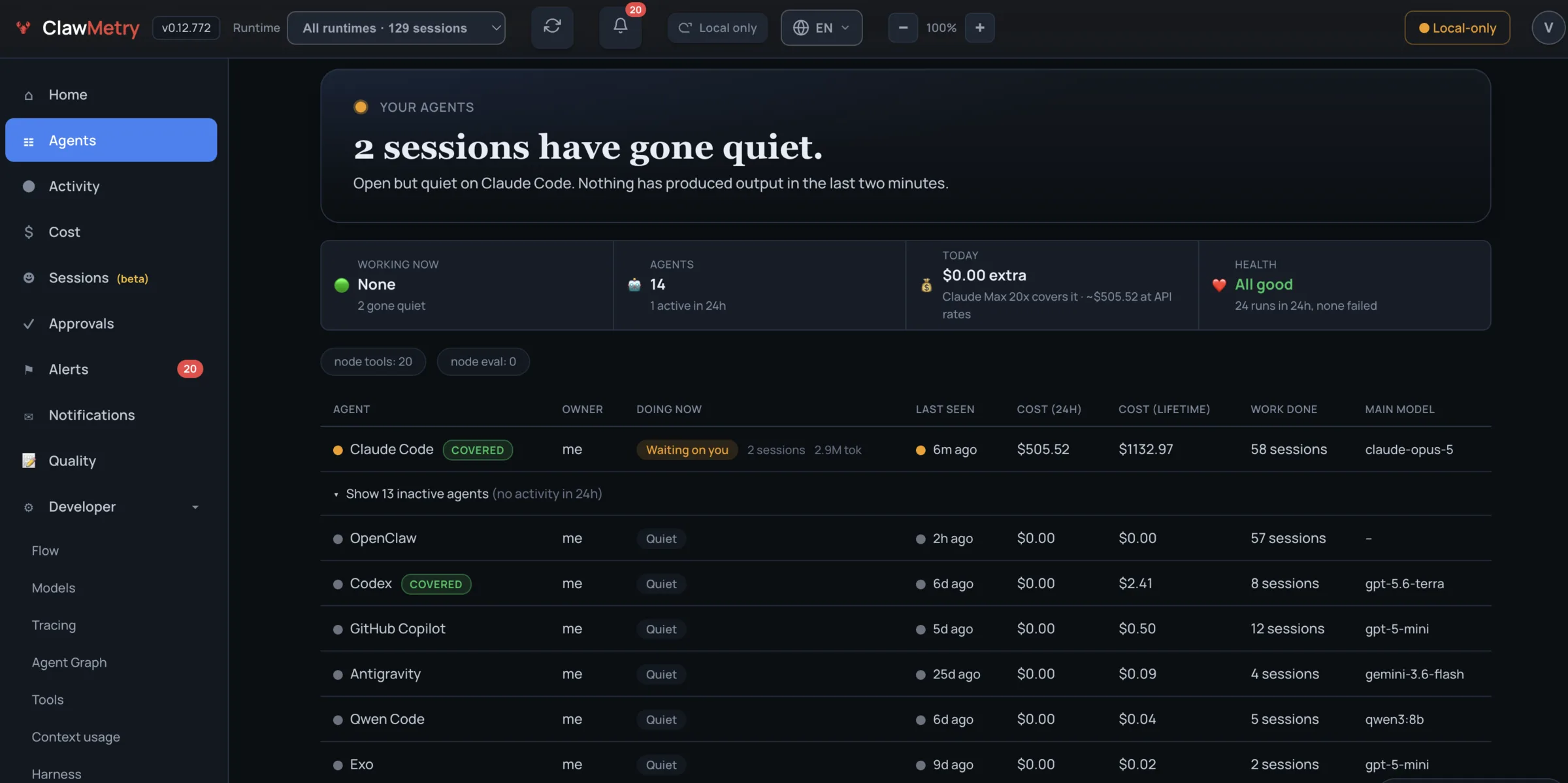
Image source: clawmetry. Published by the project; the interface may vary by version.
Limits to understand
Visibility is uneven across runtimes. The project warns that runtimes expose different data and that some publish no cost information at all. Cost reporting and comparisons across agents may therefore be incomplete. The README also distinguishes observing an action from being able to block it, so approval and enforcement capabilities must be checked for each runtime.
Network behavior should be part of the deployment review. The README says session data is not sent unless clawmetry connect is run, while an anonymous install ping and a PyPI version check run by default; it states that neither carries session content. Organizations should review the project’s EGRESS inventory against their proxy, privacy, and outbound-traffic policies, and decide whether opt-out procedures are required.
The boundary between free code and the closed-source companion also affects auditability and operating cost. The official release page lists v0.12.899, published on October 1, 2026, with release notes about a complete accounting repair for Pro upgrades. That does not replace checking the current entitlement, trial, and billing terms. The supplied sources do not confirm minimum hardware requirements, complete deployment options, or every runtime’s practical compatibility.
Deployment considerations
The README describes a local startup flow that opens the interface at localhost:8900 and provides a sample-session mode for machines without agent data. Before wider adoption, test the target runtime with representative sessions and confirm which fields are actually visible. Also review log-directory permissions, retention rules, and the exposure boundary of the local service. If a team needs sharing, cloud synchronization, approvals, or other Pro capabilities, evaluate the companion, pricing model, and resulting data flows separately.
ClawMetry is best suited to developers who want a consolidated view of several local AI agents and are prepared to distinguish what the tool can read from what it can control. It is not, based on the supplied material, a blanket guarantee of runtime governance. Results depend on the records exposed by each runtime, the selected components, and the organization’s tolerance for outbound requests and commercial dependencies.
Sources
Sources checked: 2026-10-03