

2026.09.14
Hunter Community: A Self-Hosted Financial AI Platform for Individual Investors
Hunter Community combines conversational financial research, local investment context, MCP extensibility, and quantitative workflows in a self-hosted project.
What it is
Hunter Community Edition is a financial AI agent platform aimed at individual investors. It brings conversational AI, market-data tools, research methods, and quantitative workflows into a self-hosted application. It is a fit for people who want to keep research context, portfolio information, and analysis workflows on infrastructure they control. The repository metadata lists Apache License 2.0. The README presents the project as an open-source, self-hosted tool rather than an investment adviser.
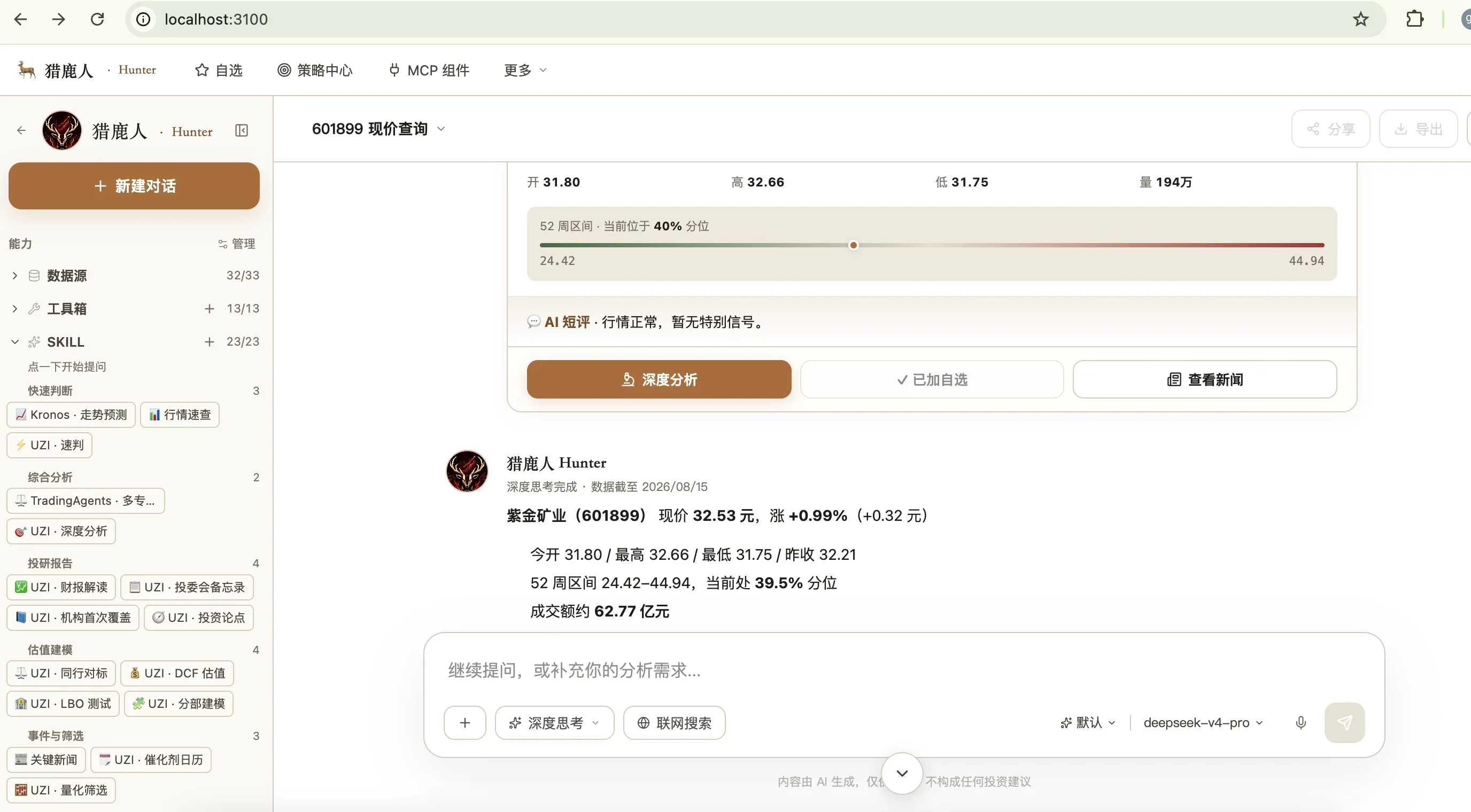
Image source: hunter-community. Published by the project; the interface may vary by version.
Known capabilities
The main interaction model is conversation combined with tool calls. The README describes market quotes, candlesticks, financial reports, news, announcements, shareholder and fund-flow information, plus streaming responses, rich cards, watchlists, portfolios, and signal tracking. Data can come from free sources, a user’s own MCP integration, or the project’s data pipeline. These paths differ in coverage and capabilities, so features described for the hosted pipeline should not automatically be treated as fully offline features.
The project also includes an investment-thesis memory workflow. It is described as recording an investment thesis, assumptions, and cost basis, then tracking changes over time; the README says this memory is stored in local Postgres. The listed SKILL collection covers areas such as deep analysis, valuation, due diligence, thesis tracking, and portfolio management. Users can also extend the capability library.
The v1.0.0 release notes add a market-wide screening interface, a research workspace, VCP-related conditions, configurable factors, backtesting, trade records, and CSV export. The same release notes explicitly say that some proposed items were not claimed as completed. Adopters should therefore distinguish released functionality from roadmap or unfinished work.
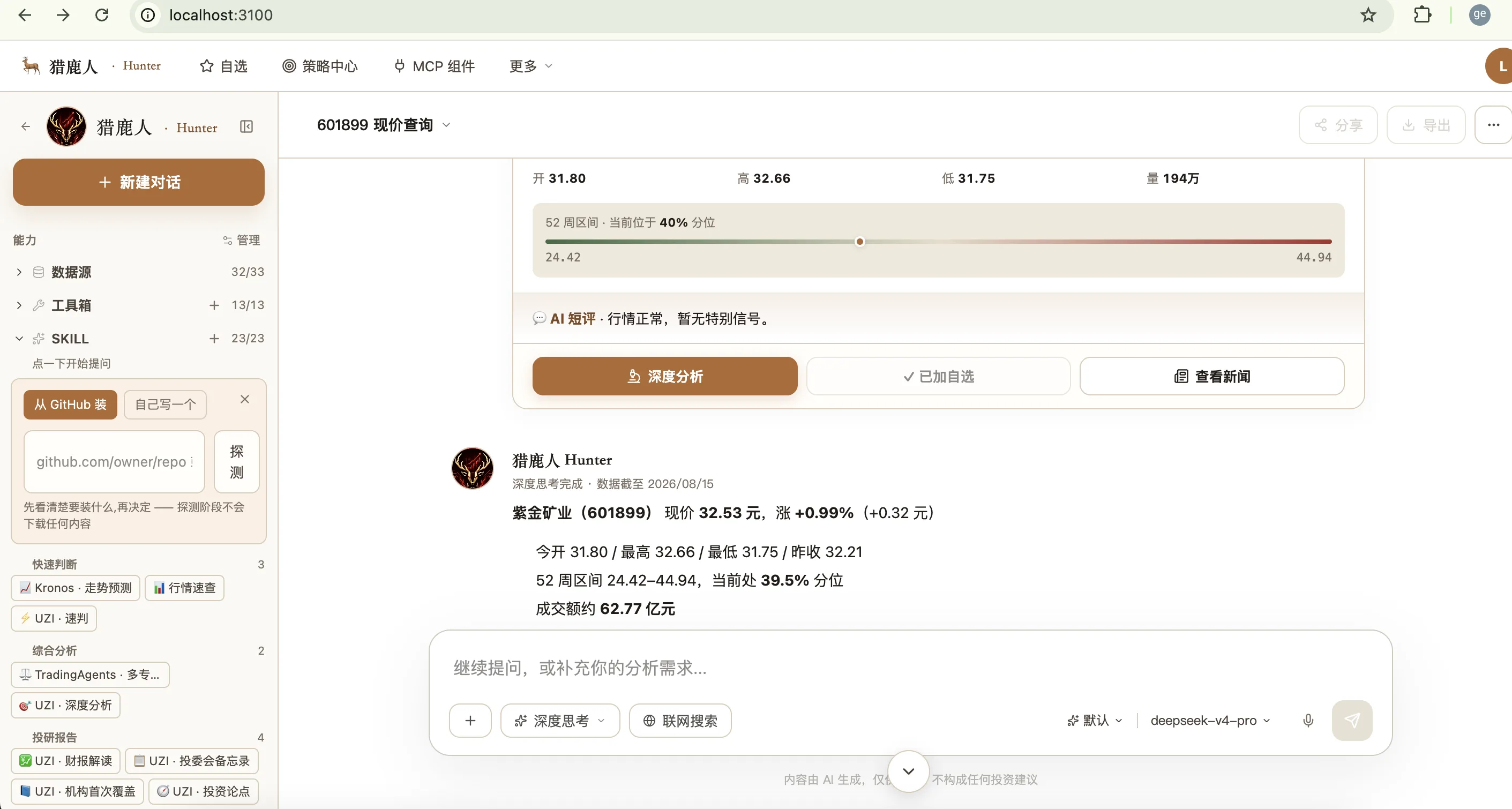
Image source: hunter-community. Published by the project; the interface may vary by version.
Who it suits
The project is best suited to individual investors, researchers, and developers who are comfortable with Docker and want a self-hosted research environment. People with existing data subscriptions or MCP servers may benefit from connecting their own tools. Those exploring the workflow can begin with the free sources described in the README. Users who only need a conventional charting terminal or a deterministic backtesting system may find the AI orchestration and provider configuration more involved than necessary.
Limitations and deployment considerations
The README lists Docker Desktop or Docker Engine with Compose v2, 20 GB of disk space, 4 GB of memory, and access to ghcr.io among the deployment prerequisites. These are documented requirements, not a guarantee of identical behavior in every environment. A model API key is required, while external data sources may introduce separate coverage, reliability, authorization, and cost constraints. The supplied sources do not confirm a single pricing model, service-level commitment, or long-term availability for every market and provider.
Local storage does not automatically provide complete security governance. Operators still need to protect environment variables, database volumes, backups, and exposed ports, and should verify the authorization scope of every data source and MCP server. The project’s disclaimer says its outputs are AI-generated research references and not investment advice. Thesis monitoring, forecasts, screens, and backtests should therefore complement—not replace—human verification, risk controls, and investment decisions.
Sources
Sources checked: 2026-09-14