

2026.10.06
LifeForge: A Modular Self-Hosted System for Personal Management
LifeForge is a modular self-hosted personal management system covering tasks, projects, finances, journaling, learning, and media organization. It suits users who want centralized control of their data and selective features, but it remains in early development and its license and deployment details require verification before adoption.
What it is for
LifeForge is aimed at people who want to reduce the fragmentation of personal-management tools. The project describes itself as a personal management system covering tasks, projects, personal goals, and financial status. Rather than focusing on one narrow workflow, it brings productivity, journaling, learning, and information organization into one self-hosted platform.
Self-hosting means that the operator is responsible for deployment and data management. The README says data is stored on the user’s own server or device and that the project does not host servers. That statement should not replace an independent review of deployment settings, access control, backups, and update procedures.
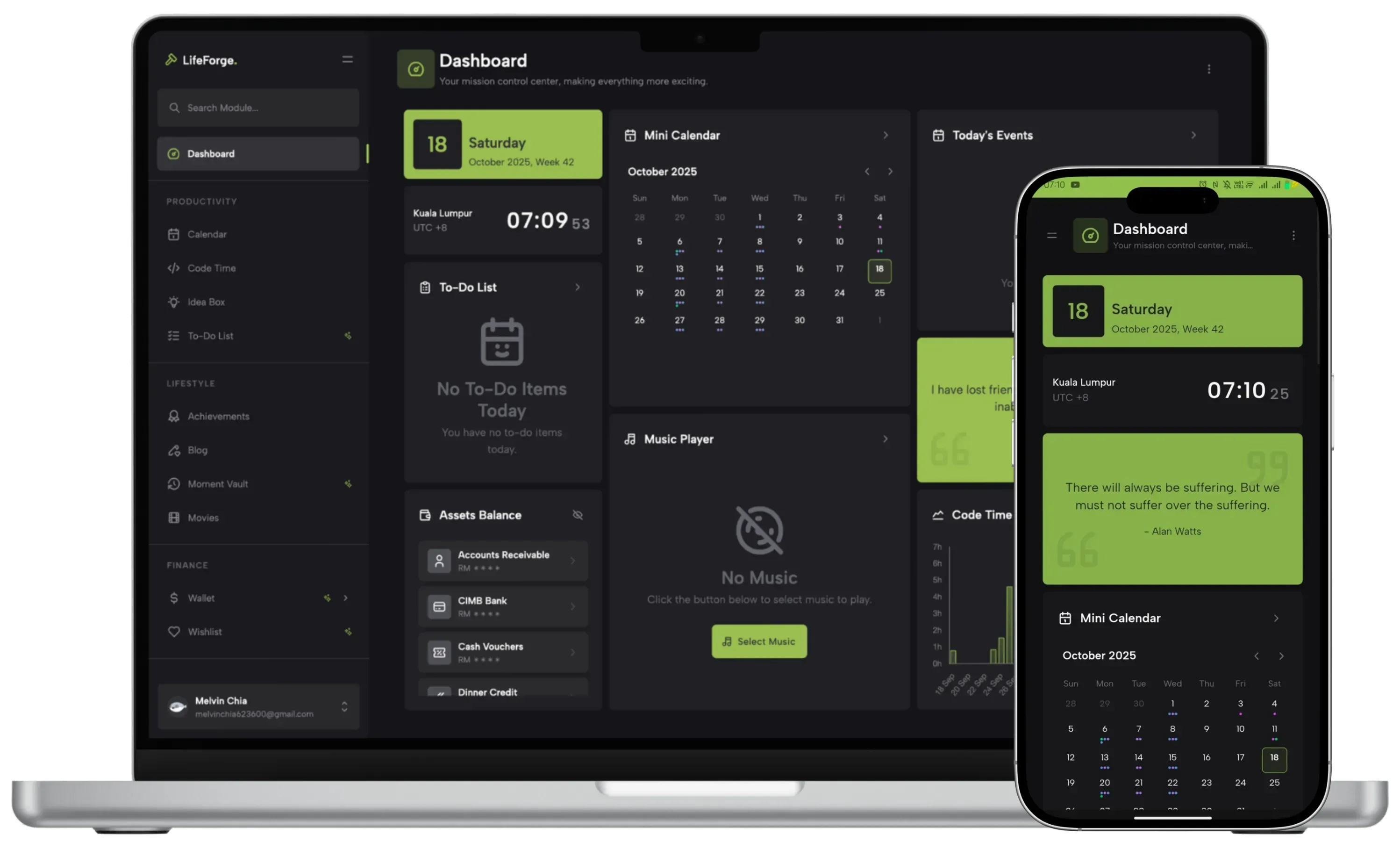
Image source: lifeforge. Published by the project; the interface may vary by version.
Features and target users
The main product concept is modularity. Users can enable the features they need instead of running a single interface filled with unrelated tools. The README lists a todo list, projects, an idea box, and a Pomodoro timer, alongside a wallet, wishlist, budget, journal, achievements, and workout tracking.
For students and lifelong learners, the project lists flashcards, notes, and CFOP algorithms. For personal collections, it mentions books, photos, music, and guitar tabs. A mail inbox and personalization module are also listed. The current availability, maturity, and installation requirements of individual modules should be checked in the official documentation and repository rather than inferred from the feature list.
LifeForge is therefore most suitable for developers, technical enthusiasts, students, and personal knowledge-management users who are willing to maintain a service and want several personal workflows in one system. It may be a poor fit for users seeking a finished, maintenance-free product.
Deployment and architectural changes
The README says LifeForge supports Docker while retaining a manual installation option, with setup instructions directed to the official documentation. Before adoption, operators should verify environment requirements, persistent storage, database or storage configuration, reverse-proxy setup, upgrade procedures, and backups. The supplied sources do not confirm minimum hardware requirements or a defined compatibility range.
The project has also completed a UI architecture migration. Its core client now uses a new internal UI system intended for module federation, with shared components, design tokens, and a common UI contract. The README says that migrating existing modules and updating documentation are still ongoing. In practice, adopters should expect uneven module maturity, review changelogs before upgrades, and keep a recoverable backup.
Limitations to check first
The repository metadata identifies the license as “Other” with an SPDX value of NOASSERTION. Based on the supplied sources, the exact open-source license, redistribution terms, and commercial-use boundaries cannot be confirmed. Teams and commercial operators should inspect the repository’s LICENSE file and official documentation directly.
The README also explicitly says the project is still in early development and that features and modules may change. Claims such as no telemetry or local storage should not be treated as a complete security guarantee; operators still need to handle authentication, HTTPS, backups, updates, and network exposure. The project preserves a legacy-final release from before the UI migration, but it is no longer actively developed and should not be treated as a substitute for the current branch.
Overall, LifeForge’s appeal is its modular consolidation and user-controlled hosting. The trade-off is that deployment, maintenance, and license verification remain the adopter’s responsibility.
Sources
Sources checked: 2026-10-06