

2026.10.08
Pulse: A Self-Hosted Monitoring Workspace for Mixed Infrastructure
Pulse brings Proxmox, Docker, Kubernetes, TrueNAS, and several host platforms into one self-hosted monitoring workspace. It combines history, alerts, recovery visibility, and scheduled checks, while vSphere remains early access and AI capabilities vary by edition.
What it is for
Pulse is a self-hosted monitoring workspace for infrastructure operations. Rather than presenting only live metrics for one platform, it combines current state, historical data, alerts, recovery visibility, and scheduled health checks in one interface. The repository is licensed under the MIT License, making it relevant to homelab operators, small teams, and administrators responsible for multiple environments who want to run the monitoring service themselves.
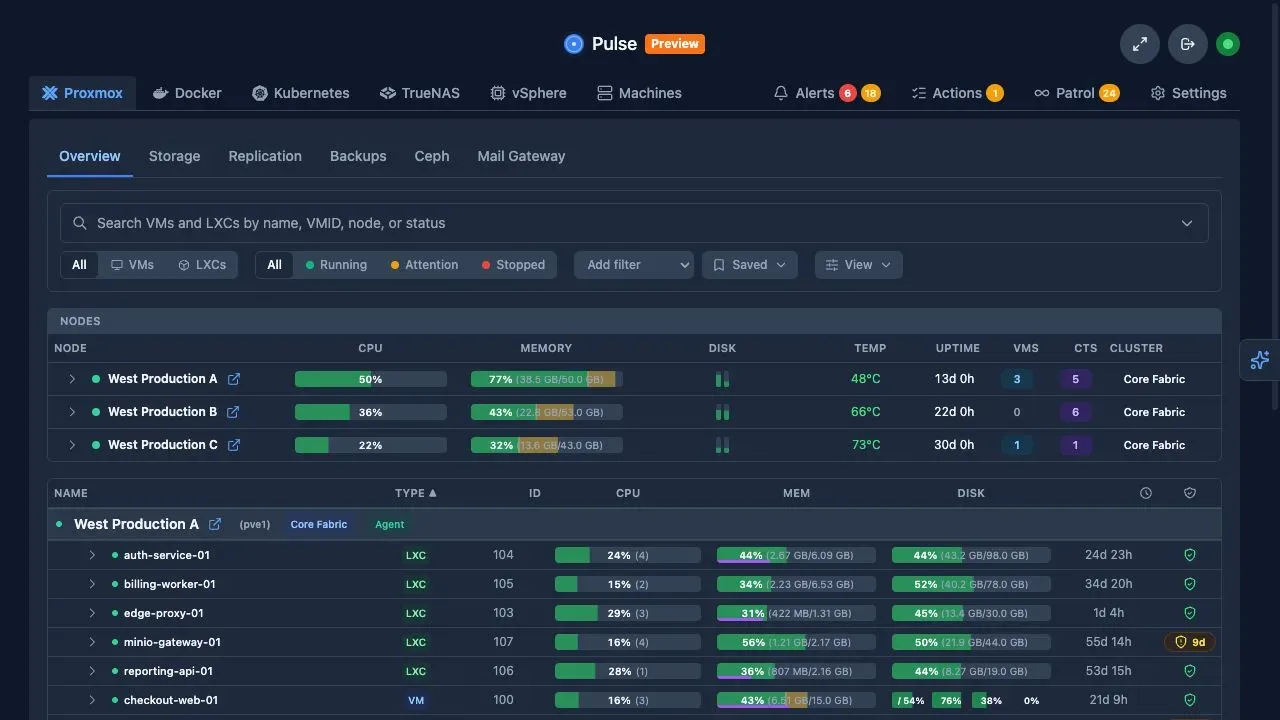
Image source: Pulse. Published by the project; the interface may vary by version.
Known capabilities
The project covers Proxmox VE, Proxmox Backup Server, Proxmox Mail Gateway, Docker, Podman, Kubernetes, TrueNAS SCALE and CORE, plus Linux, Windows, and macOS machines. The README also lists VMware vSphere as early-access coverage and explicitly recommends validating it against the user’s own vCenter before production use.
Each platform has dedicated views, while a shared resource model supports search, alerts, history, and investigation. The monitored objects vary by platform. Proxmox coverage includes nodes, guests, storage, backups, replication, Ceph, and mail gateways. Docker and Podman coverage includes containers, Compose projects, Swarm services, health, images, and updates. Kubernetes coverage includes clusters, nodes, workloads, pods, services, storage, and events.
Pulse Patrol performs scheduled checks against current infrastructure state and recent history. The README gives examples such as failed backups, capacity pressure, restart loops, unhealthy containers, and clock drift. Community installations can use a local model or a user-selected AI provider for watch-only analysis. The project also describes an interactive Assistant and an MCP adapter for external clients.
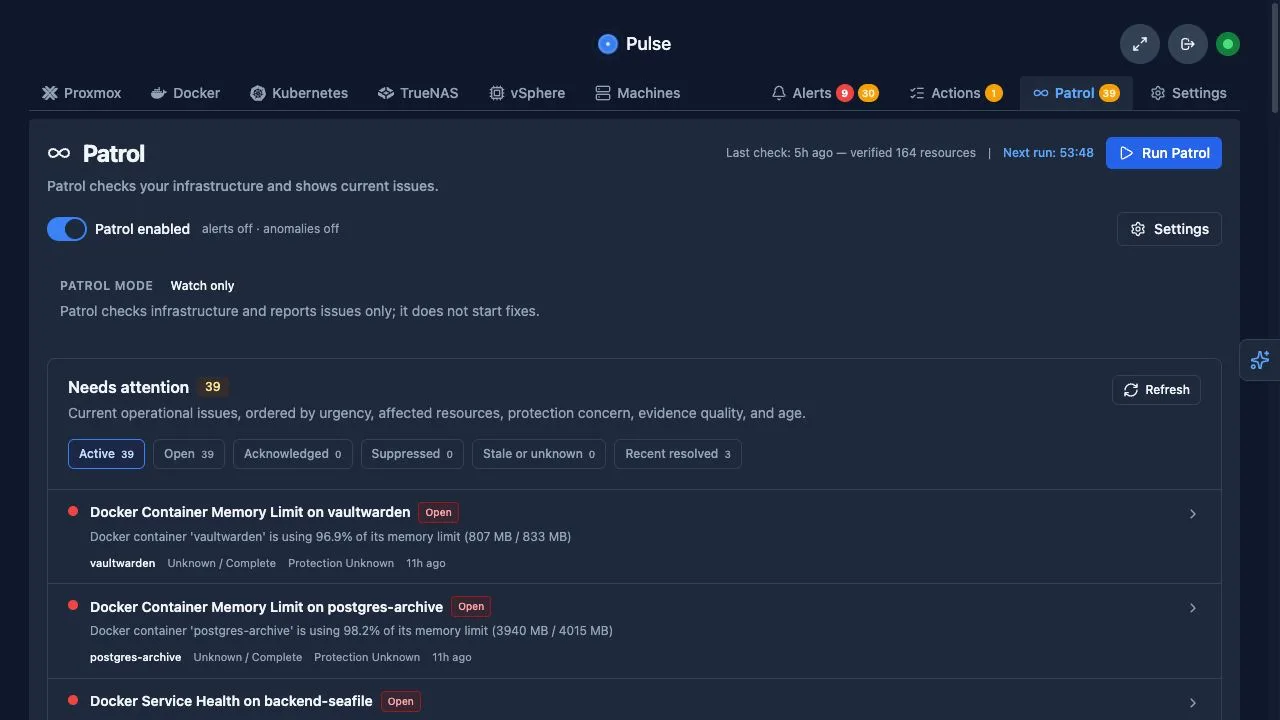
Image source: Pulse. Published by the project; the interface may vary by version.
Limitations before adoption
The AI and remediation story should not be treated as identical across editions. The README separates Community from Pro: investigation, policy-bound fixes, approval, verification, and an audit trail belong to Pulse Pro. Community Patrol is described as watch-only analysis. Its usefulness will therefore depend on the selected model, available telemetry, and alert configuration; the supplied sources provide no accuracy or performance guarantee.
vSphere is marked early access, so production users should test their own vCenter integration first. The sources do not provide a universal minimum hardware specification, resource profile, or complete compatibility matrix. Deployment scale should not be inferred from the project overview alone. For installation, the README recommends selecting an exact release version and keeping it pinned. The supplied v6.5.0 release is a stable minor release with improvements to alert recovery, notification retries, history charts, backup coverage visibility, and Patrol summaries, but those notes are not a guarantee of stability in every environment.
Deployment considerations
Official documentation lists Docker, Proxmox LXC, Linux, and Kubernetes/Helm deployment paths. The README specifically says Docker host monitoring is provided by the unified agent and that the Pulse server container does not need the Docker socket. This can avoid one common container privilege exposure, but it is not a blanket security conclusion for the whole deployment.
The project describes encrypted credentials at rest, scoped API tokens, and disabled agent commands by default. Administrators should still review the official production, security, and privacy documentation and assess network boundaries, access control, backups, and upgrade procedures for their own environment.
Sources
Sources checked: 2026-10-08