

2026.10.07
RSSMonster: An Organizable RSS Reader for Self-Hosting
RSSMonster targets readers who want control over subscriptions, reading state, and storage. It offers multiple reading modes, search, Smart Folders, rule-based automation, and optional intelligent analysis. Deployment choices differ substantially, especially between the desktop, SQLite, and MySQL profiles.
Project overview
RSSMonster is an open-source, self-hosted RSS reader built with Vue and Express and released under the MIT License. It is aimed at people who want to manage their own sources, subscriptions, and reading state rather than rely on a hosted reading service. The project provides a web deployment and an Electron desktop application.
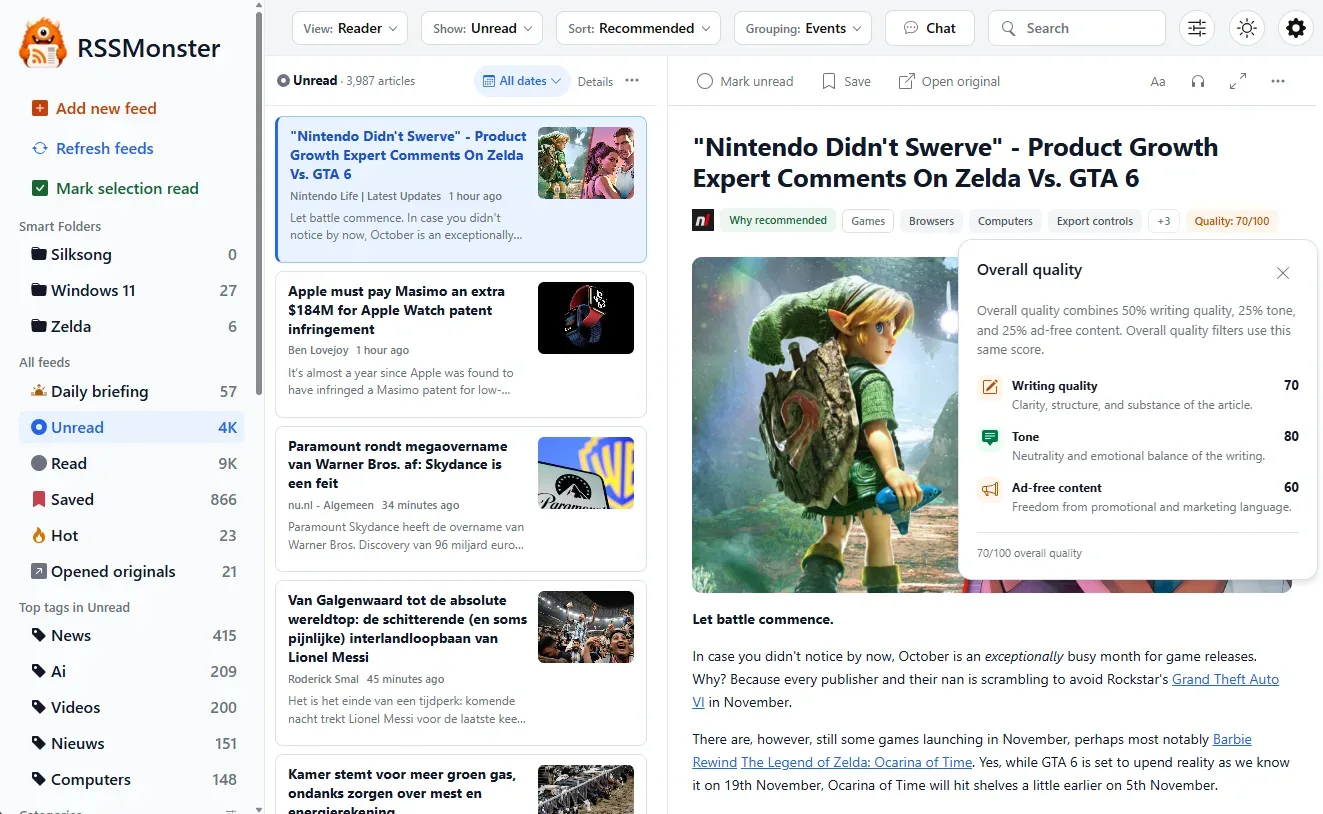
Image source: rssmonster. Published by the project; the interface may vary by version.
Who it suits
RSSMonster is a good fit for readers with established subscriptions who want to filter, organize, and revisit articles using their own rules. OPML import and export make it suitable for migration from another reader, while categories, tags, bookmarks, and search support research collections, project monitoring, and everyday news reading.
Users who prefer chronological reading can stay with the conventional reader views. Those with more structured workflows can save searches as Smart Folders, creating reusable views whose matches update automatically. Regular-expression actions can also bookmark, mark as read, tag, hide, or adjust scores for incoming articles.
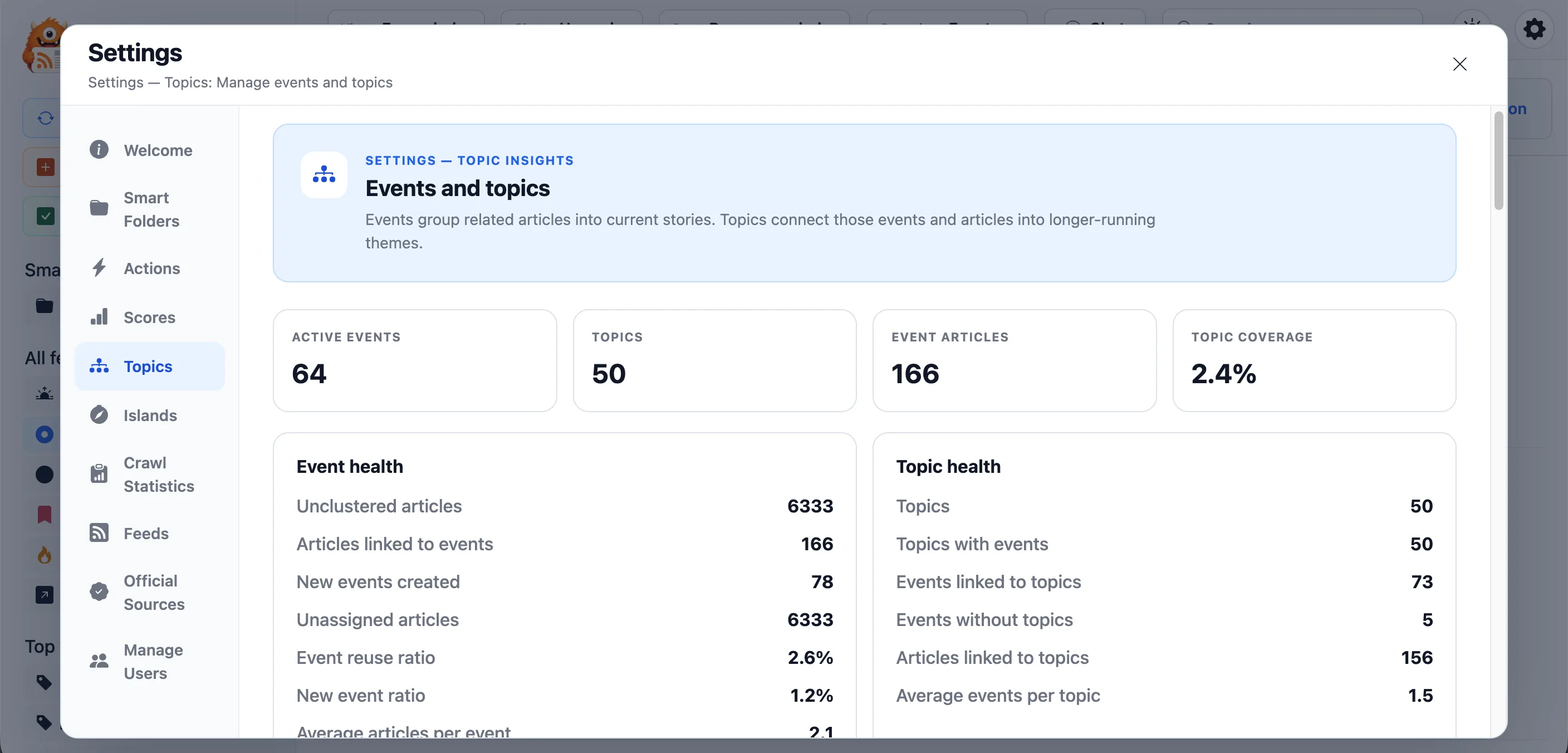
Image source: rssmonster. Published by the project; the interface may vary by version.
Documented capabilities
The reader provides Reader, Expanded, Summarized, Headlines, and Summary Bullets modes, along with keyboard shortcuts, light or dark themes, bookmarks, and mobile gestures. Search can combine words with dates, article state, tags, and supported score or semantic filters.
Events group reports about an occurrence. Interest Islands model recurring interests from reading feedback. Recommended, Top Stories, and Quality offer different ordering perspectives. The documentation explicitly distinguishes these signals from fact checking. An optional assistant can answer questions about stored articles using source-based context, but it is configured separately from local embeddings, summaries, tags, and scoring.
The project also documents HTML + XPath feeds for following server-rendered sites without a usable RSS feed. Generated feeds can expose a search or Smart Folder as a private, token-protected RSS URL. Fever and Google Reader compatibility are available for clients that support those documented interfaces.
Deployment limits and considerations
The deployment profiles should not be treated as interchangeable. The SQLite quick start is intended for lightweight personal reading, but the documentation says it does not include a bundled inference service or AI worker. Background intelligent processing therefore requires separately configured inference and worker components. The more comprehensive MySQL deployment includes crawling and AI workers and supports local model processing. MariaDB can also be used with the documented dialect setting.
The Electron desktop edition uses a local SQLite database and does not require Docker or a separate server, making it suitable for local reading. However, the v2.3.0 release notes state that the first desktop release requires manual feed refresh and does not include scheduled crawling, background workers, Web Push, email delivery, or inference-backed AI features. The installers are currently unsigned, so operating systems may show a trust warning. The desktop application downloads local AI models on first launch, but that does not mean the initial desktop release includes the full AI workflow.
Before enabling external inference, SMTP email, or browser Push, operators should review where article and account data will be sent. Models, credentials, startup procedures, backups, and maintenance should follow the official deployment documentation. The supplied sources do not confirm a universal minimum hardware requirement, so no machine specification can be inferred.
Sources
Sources checked: 2026-10-07