

2026.09.16
SiYuan: A Privacy-First Self-Hosted Workspace for Personal Knowledge
SiYuan fits people who want fine-grained knowledge organization and control over their data. Its broad feature set comes with deployment, paid-feature, access-control, and AGPL considerations.
What it is
SiYuan is a privacy-first personal knowledge management system that can also be operated as a self-hosted knowledge workspace. Its model is based on content blocks, with block-level references, bidirectional links, and Markdown WYSIWYG editing. This makes it suitable for turning notes, source material, and long-term documentation into reusable structures. The repository presents it as a workspace where humans and AI agents can collaborate, but that description should not be interpreted as proof that every AI capability runs locally.
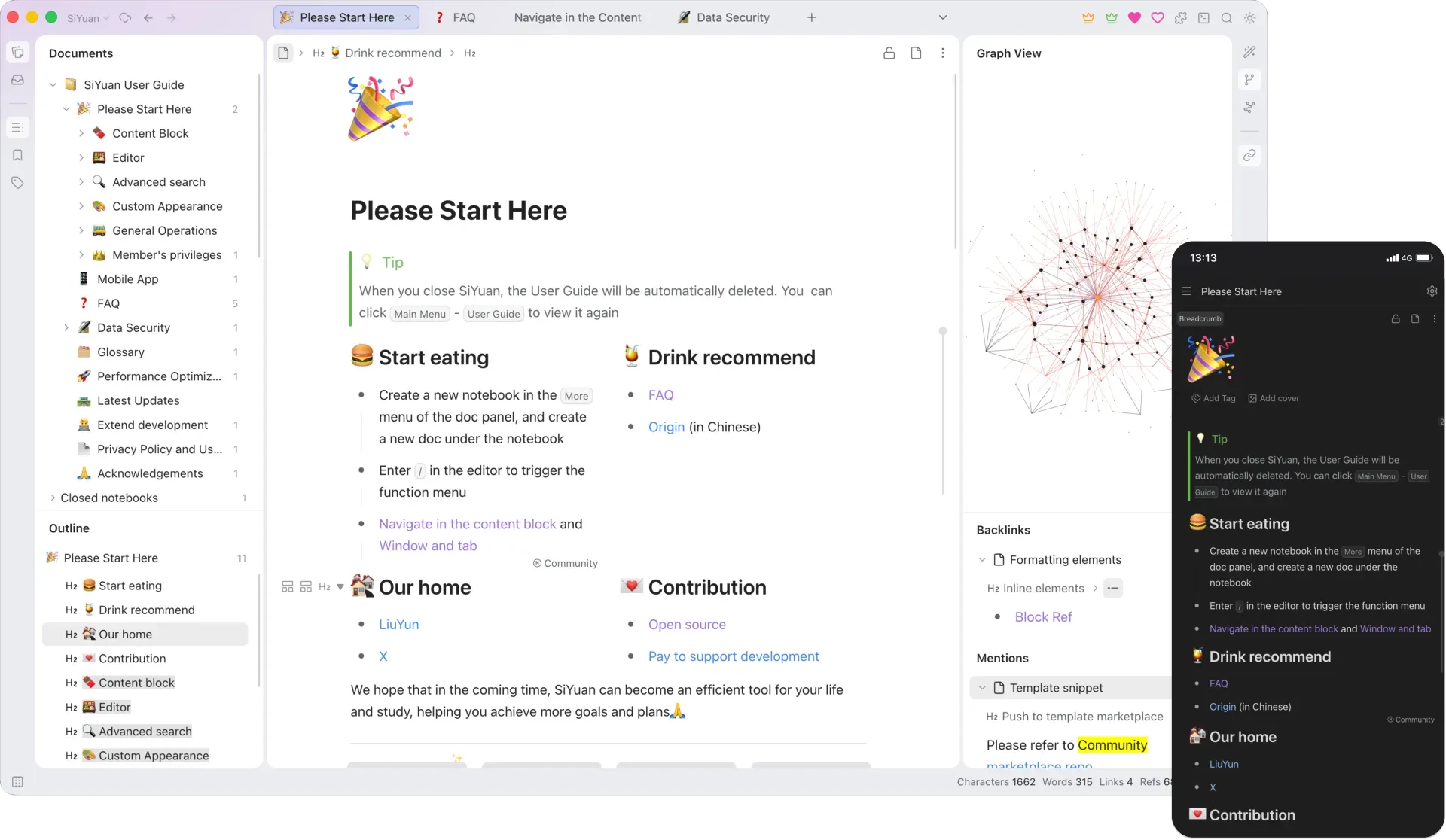
Image source: siyuan. Published by the project; the interface may vary by version.
Who it suits
SiYuan is aimed at researchers, developers, writers, students, and individual knowledge-base maintainers who need fine-grained organization. Block references, document trees, databases, and table views can support project material, reading notes, technical documentation, or review cards. People who want to access one knowledge workspace across desktop, mobile, and a server can use the listed Android, iOS, and HarmonyOS apps, as well as Docker deployment.
Users who mainly need lightweight temporary notes may find the block model, workspace concepts, and extension ecosystem more involved than necessary. This article does not make independent claims about performance, synchronization reliability, or security.
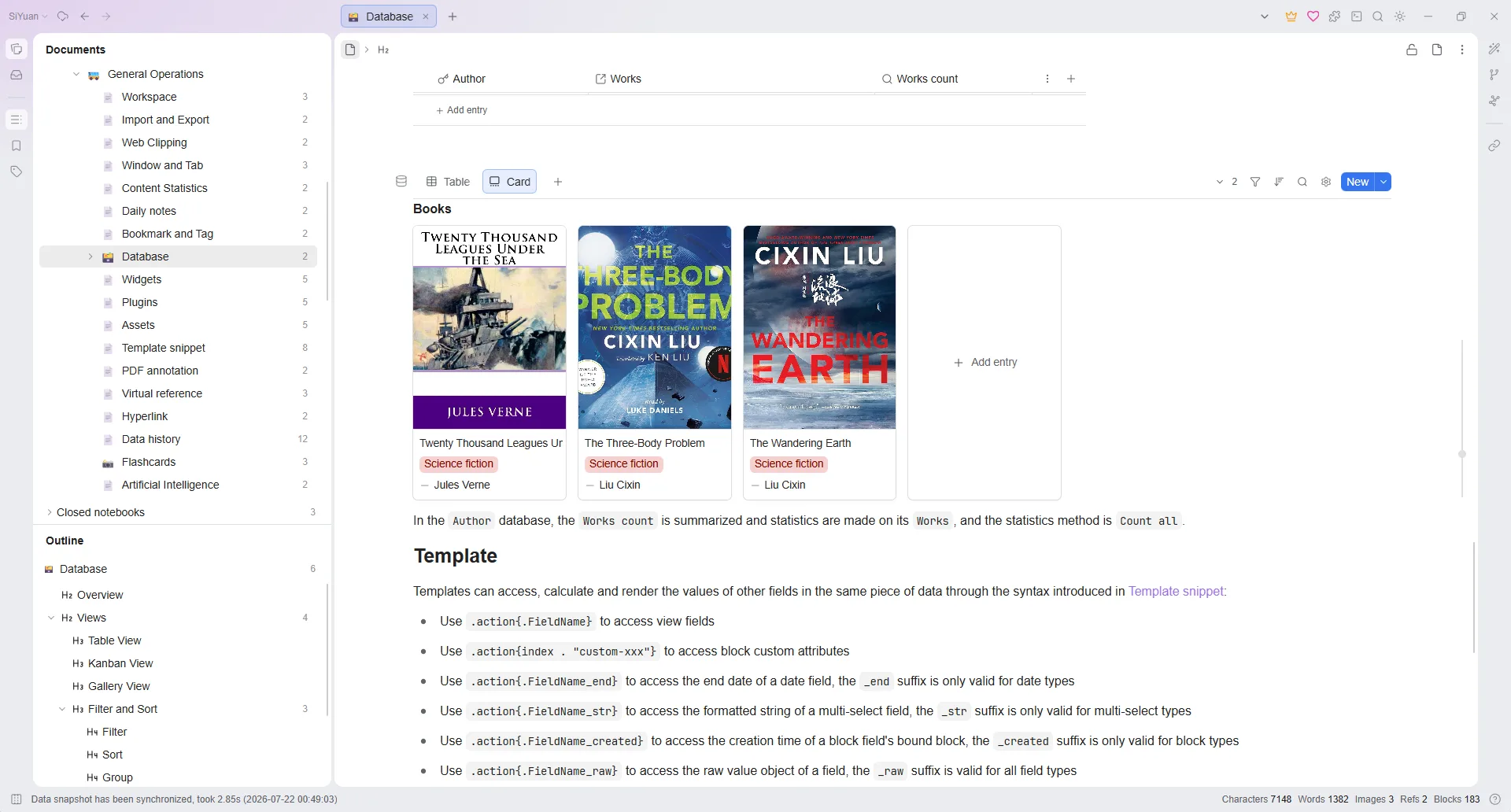
Image source: siyuan. Published by the project; the interface may vary by version.
Documented capabilities
The README lists block references and bidirectional links, custom attributes, embedded SQL queries, outlines, block zoom, mathematical formulas and several diagram types, web clipping, PDF annotation links, PDF/Word/HTML export, databases, table views, spaced-repetition flashcards, Tesseract OCR, templates, JavaScript/CSS snippets, an API, plugins, and a community marketplace. It also lists AI writing and Q&A through the OpenAI API.
The v3.8.3 release notes mention remote-kernel connections, on-demand asset downloads, MCP compatibility, improved agent sessions, and Responses API support from non-OpenAI providers. These are release-note statements; adopters should still verify the exact configuration and availability against the target version.
Deployment and adoption considerations
Self-hosting requires a plan for the workspace directory, backups, access control, and upgrades. The README documents a Docker image and says that, since v3.7.0, the serve subcommand must be passed explicitly. It also documents workspace settings, an access authentication code, and PUID/PGID configuration for the container user. Before exposing the service remotely, configure authentication rather than publishing an unprotected workspace. This is operational guidance, not a claim that the project has been independently audited or is inherently secure.
The project uses AGPL-3.0. Teams modifying it, offering it over a network, or integrating it into another product should assess their obligations based on the actual distribution and service model. The README also says that some features are available only to paid members, so “open source” should not be treated as evidence that every capability is free. Synchronization, third-party services, AI providers, mobile behavior, and plugin quality should be validated with a small, representative dataset before migration.
Overall, SiYuan is a stronger fit for individuals or small teams willing to invest in information architecture and operational maintenance. Its documented strengths are block-level organization, multiple client forms, and extensibility. Before adoption, confirm the target version, paid-feature boundaries, backup process, remote-access design, and AGPL compliance requirements.
Sources
Sources checked: 2026-09-16