

2026.10.03
Temps: A Self-Hosted Platform for Deployments, Observability, and AI Sandboxes
Temps is a Rust single-binary self-hosted platform covering Git deployments, analytics, error tracking, OpenTelemetry, email, and AI sandboxes for teams that want one operational surface.
What it is for
Temps targets developers and small platform teams that want to keep deployment and operational data on infrastructure they control. The repository describes it as a Rust single binary combining application delivery, observability, analytics, email, and AI workflow capabilities. Its positioning as an alternative to several hosted products is the project’s own description, not proof of feature or operational parity.
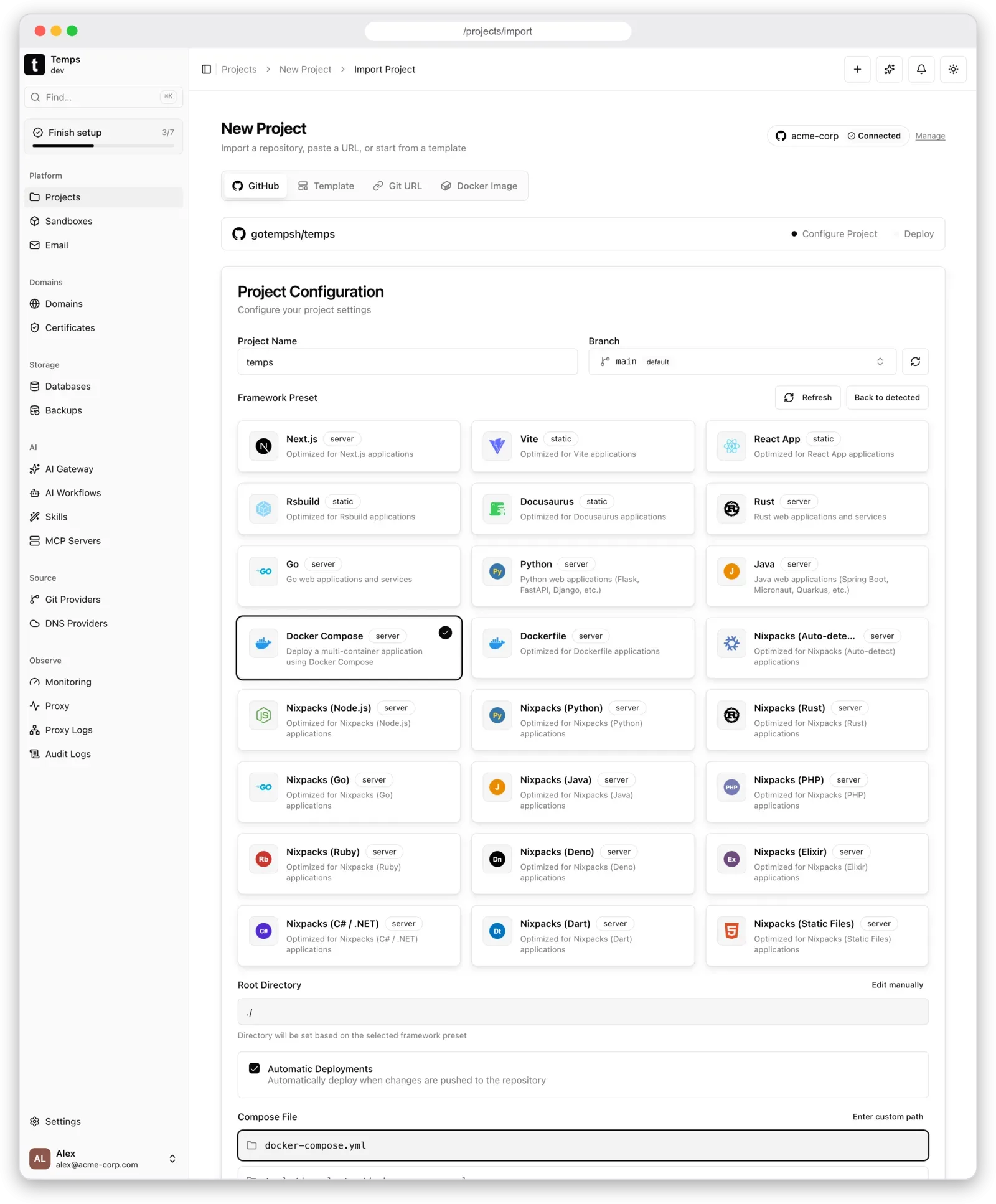
Image source: temps. Published by the project; the interface may vary by version.
Known capabilities
The README claims more than 440 CLI operations across 69 groups, with dashboard actions also exposed through the CLI. It includes skills for Claude Code, Codex, and OpenCode, making it relevant to teams that want coding agents to participate in deployments, migrations, domain management, and diagnostics.
For delivery, the project lists Git push deployments, preview URLs, automatic TLS, language detection, and custom Dockerfiles. It also lists Postgres, Redis, S3-compatible storage, and MongoDB services. Availability, backup behavior, and operational requirements should be checked against the documentation for the version you deploy.
The observability surface includes web analytics, funnels, visitor tracking, rrweb session replay, Sentry-compatible error tracking, request logs, uptime monitoring, and OpenTelemetry traces, metrics, and logs. Its AI Gateway accepts customer-owned keys for OpenAI, Anthropic, xAI, and Google Gemini through an OpenAI-compatible endpoint. The project says keys are encrypted on the server; operators should still review access control and key-management behavior in their own deployment.
For code execution, the README describes Firecracker microVM sandboxes and says Docker is the default backend. It also lists a sandbox SDK with a @vercel/sandbox-compatible shape, preview URLs, and password protection. These claims should not be treated as a complete security assessment or as a substitute for testing isolation in the intended threat model.
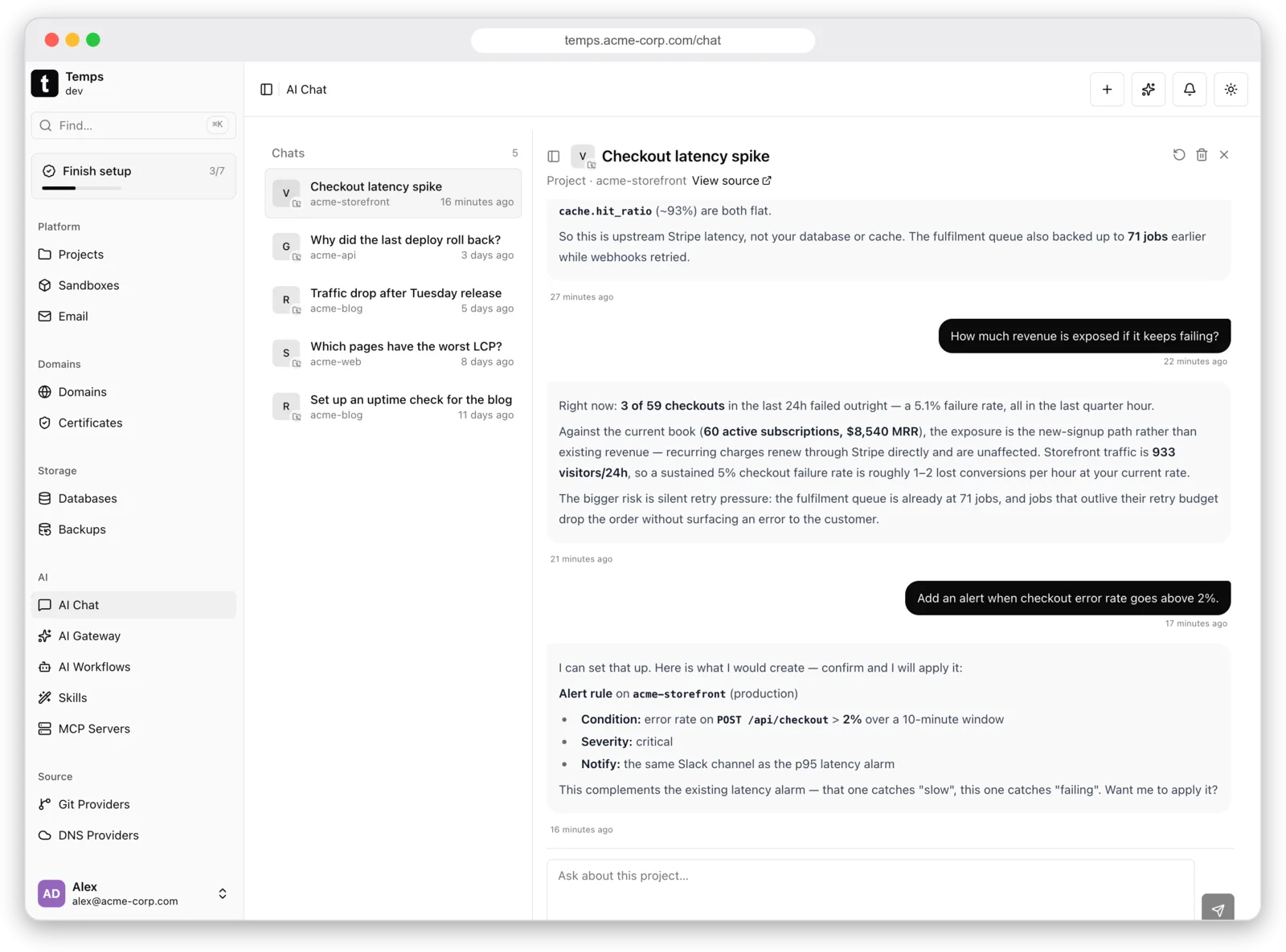
Image source: temps. Published by the project; the interface may vary by version.
Who may benefit
Temps may suit indie developers, small product teams, and platform engineers who prefer one control plane for deployments, logs, errors, analytics, and AI tooling. Teams already using OpenTelemetry, Sentry SDKs, or agent-based development may find the listed integration points useful. The trade-off is responsibility for servers, domains, credentials, backups, upgrades, and incident response.
Limits before adoption
The project is still presented through an early release; the supplied official release is v0.0.8. A broad feature list does not establish production maturity for every subsystem. Databases, email, sandboxes, certificates, backups, and multi-node setups deserve separate validation. The README also states that Temps does not provide edge functions or a global edge network, and it does not yet have a one-click template library.
Repository metadata identifies Apache License 2.0, while the repository also contains an MIT license file. Do not assume every component uses one license; review the relevant directories and dependencies. The supplied sources do not establish minimum hardware, capacity guidance, or performance figures, so none are asserted here.
Deployment considerations
Before deployment, confirm the operating system, architecture, DNS, TLS, Git-provider credentials, reverse-proxy arrangement, and outbound email path. The v0.0.8 release lists installation paths for macOS, Linux, WSL, Linux AMD64, macOS Intel, and Apple Silicon; that does not establish validation for every production topology.
If you enable replay, telemetry, databases, or AI sandboxes, estimate storage, network, retention, and backup needs. Test upgrades and rollback, permission separation, credential rotation, and recovery before moving important workloads. The safest starting point is a small, representative environment with clear data-retention and isolation expectations.
Sources
Sources checked: 2026-10-03