

2026.10.03
World Monitor: An Open Dashboard for Global News and Signals
World Monitor combines news, geopolitical monitoring, infrastructure tracking, maps, indices, and market signals. Before adoption, review data credentials, source quality, deployment needs, and AGPL obligations.
What the project is for
World Monitor is a real-time global intelligence dashboard intended to combine news aggregation, geopolitical monitoring, and infrastructure tracking in one interface. It is better understood as an information-gathering and situational-awareness tool than as a replacement for specialist verification, analysis, or emergency decision-making. The README also presents it as usable by browsers, agents, and scripts, making it relevant to individual researchers and teams building internal monitoring surfaces.
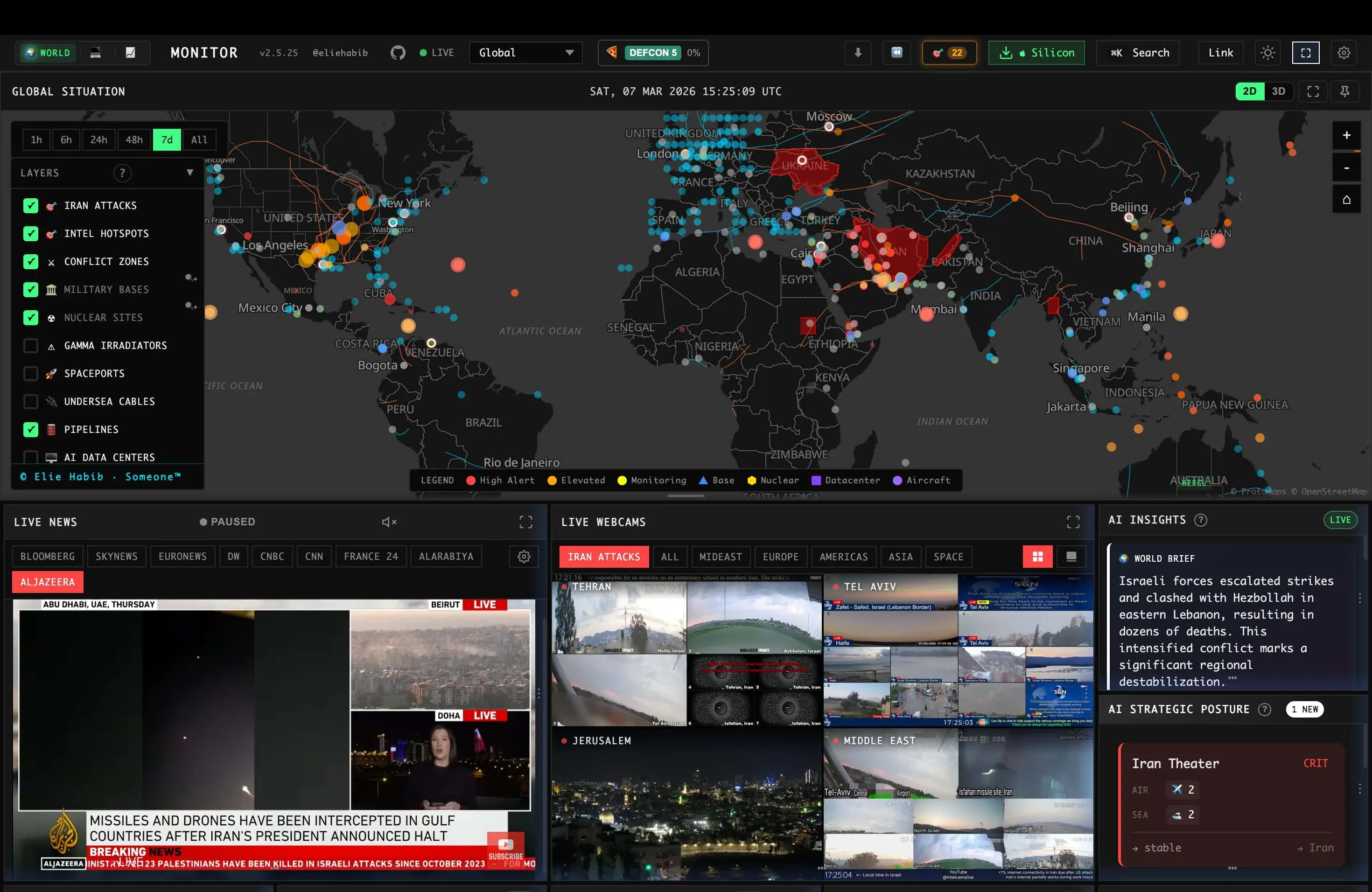
Image source: worldmonitor. Published by the project; the interface may vary by version.
Known features
The project offers curated global and regional news feeds and can synthesize them into briefs. Its mapping layer includes both a 3D globe and a WebGL flat map, with a shared catalog of map layers. Military, economic, disaster, and escalation signals can be correlated across streams. The Country Instability Index (CII) provides scores, bands, and approximate 24-hour movement for 31 Tier-1 countries, while the finance radar covers exchanges, commodities, crypto, and a market composite.
AI does not have to be cloud-only. The README lists Ollama, Groq, OpenRouter, and browser-side Transformers.js, and specifically describes Ollama as a way to run local AI without API keys. The interface also supports multiple languages, native-language feeds, and RTL. The v2.10.0 release notes list Traditional Chinese and Swahili support among its changes.
Who it may suit
World Monitor may suit open-source practitioners, OSINT learners, researchers, editors, and engineering teams that need a shared view of public information. A single codebase includes world, tech, finance, commodity, happy, and energy variants. A Tauri 2 desktop application is listed for macOS, Windows, and Linux. Teams with existing agent or integration workflows may also find the MCP server, REST API, CLI, and SDK direction useful.
Limitations before adoption
The README says the application can run without environment variables, but feature-specific data sources may require credentials. A successful startup therefore does not mean that every data feature is available. Prospective operators should review each source, its authorization terms, refresh behavior, and credential-handling requirements. The supplied sources do not confirm complete minimum hardware requirements, uniform provider reliability, or suitability of the CII and AI summaries for high-stakes decisions.
Aggregation and summarization can introduce coverage gaps, freshness issues, false positives, and interpretation bias. Maps, indices, and correlation views should be treated as supporting signals; important findings still need to be checked against primary sources. The project describes its public sites and desktop binaries as stable, but that does not establish identical guarantees for every provider, deployment mode, or feature.
Deployment and licensing
The README’s development path uses a repository checkout, dependency installation, and a development server. For self-hosting, it points to Vercel, Docker, and static deployment options. Before deployment, clarify whether the chosen setup needs Redis, edge functions, a relay, AI services, or additional source credentials, and assign responsibility for caching, logs, access control, and upgrades.
The source code is licensed AGPL-3.0-only. Self-hosting, modification, and commercial use are not automatically prohibited, but network use or redistribution can trigger source-availability, attribution, and other obligations. Teams should review the license against their architecture before launch. The README also mentions a commercial licensing option for organizations that need non-AGPL terms.
Sources
Sources checked: 2026-10-03